Deterministic
Code Architecture
Without Bloat.
Krnl reads your entire Abstract Syntax Tree structure cleanly before executing micro-diff iterations. No hallucinated functions. No out-of-bounds mutations.
Global Lexical Understanding
Krnl parses scopes and function linkages natively prior to generating code tokens.
Optimized sub-graphs omit non-critical source modules dynamically.
Parallel lexical synthesis trees verify modifications in real-time.
Strict mapping rules eliminate out-of-scope model syntax drift.
Isolated compiler verification ensures output passes local syntax checks.
Architected for deep engineering isolation
An execution matrix optimized for high-throughput, low-entropy production workflows. Every capability maps directly to strict compiler discipline, security boundaries, and absolute auditing integrity.
RAZOR_MODE
YAGNI-first minimal coding discipline. Enforces a strict productivity ladder—standard library first, then existing dependencies, then minimal isolated code mutations.
MULTI_MODEL_ROUTING
Unified API aggregation layer across top-tier foundation models. Executes automatic failover and token escalation routines dynamically upon structural response drops.
CODE_KNOWLEDGE_GRAPH
Tree-sitter driven abstract syntax tree indexing engine. Cross-references modules, classes, structural imports, and invocation dependencies in sub-millisecond timelines.
CLI_THEMES_SPINNERS
Low-latency console styling pipeline featuring 4 deterministic industrial color schemes, 8 hardware spinner matrices, and dynamic context-aware telemetry labels.
FINE_GRAINED_PERMISSIONS
Granular sandbox isolation vectors restricting broad outbound HTTP requests, absolute file system pathways, and system runtime environment maps via YAML blueprints.
CONTEXT_MEMORY_VAULT
Deterministic codebase embeddings, historical workspace snapshots, and session execution states compressed into high-speed local indices for instant key query recall.
IMMUTABLE_AUDIT_LOGS
Cryptographically distinct tracking capturing prompt sequences, LLM chain reasoning paths, tool execution arrays, and raw workspace file patch histories.
INTEGRATED_ENVIRONMENTS
Direct execution extensions bridging IDE contexts natively via VS Code or continuous automated code validation and deployment structures across GitHub Actions.
COMPOSABLE_ADAPTERS
Strictly typed execution adapters built to dynamically hook into local HTTP services, automated SQL migrations, security scanners, and static code linters.
RAZOR_MODE: ANNIHILATE COGNITIVE BLOAT.
Generative AI entities inherently exhibit high semantic entropy—they over-generate boilerplate infrastructure. Razor Mode targets this with a hard-coded YAGNI-first compilation hierarchy engineered straight into the system nucleus. Smaller diff payloads, zero structural dependencies, clean maintenance.
Surgical compilation adjustments only. Block generation of fresh isolated modules unless standard structural libraries are completely mathematically incapable of resolution.
Standard Razor structural containment. Structural abstractions are immediately rejected unless they explicitly earn their keep via direct dependency consolidation.
Absolute code destruction profile. Enforces high-performance shell pipeline one-liners over complex script blocks. Reclassifies boilerplate as system noise.
def process_items(items):
    """Process a list of items and return results."""
    results = []
    processor = ItemProcessor()
    for item in items:
        processed = processor.process(item)
        results.append(processed)
return ResultCollection(results)Code Knowledge Graph: Understand without reading.
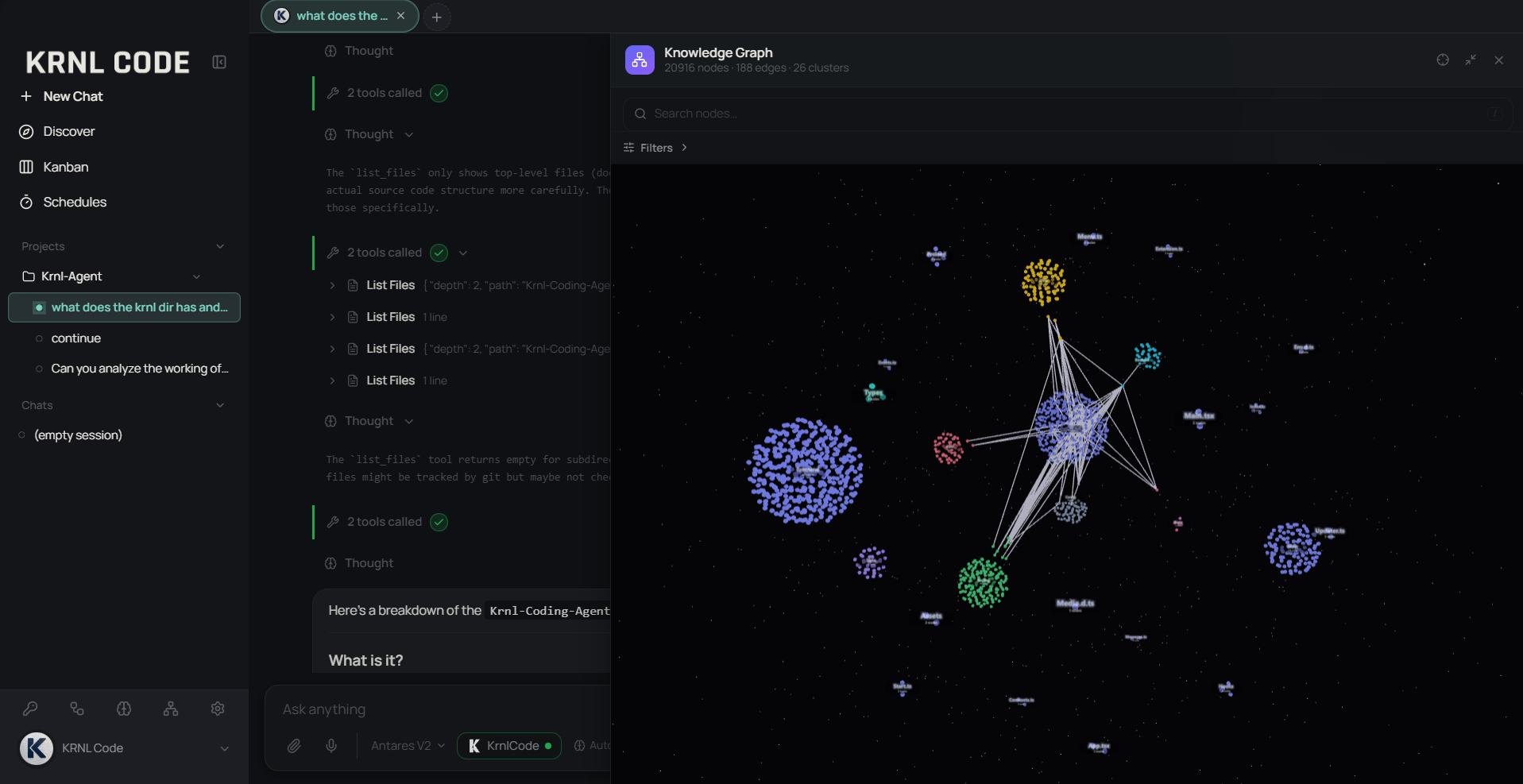
Krnl doesn't grep your files—it transforms your repository layout into a living, high-fidelity relational matrix. Every class inherit, module import, and method execution path is compiled down to micro-millisecond queries instantly.
Krnl utilizes direct Tree-sitter syntactic scopes combined with an isolated WAL-mode persistence array to guarantee full graph mutations inside sub-millisecond timelines.
Graph Schema — every node tells a story
The full knowledge graph schema showing how modules, classes, functions, and their relationships are connected.
From idea to production — without leaving the terminal
Other platforms abandon you once the file is written. Krnl unifies your workflow directly, actively processing everything from sandboxed creation logs straight through self-healing rolling deployments.
Smart task decomposition
Krnl reads your AGENT.md, inspects the repo map, and builds a step-by-step plan before touching a single file. You approve or adjust before execution begins.
Control agents with a declarative blueprint
Eliminate fragile state layers. Govern runtime behavior explicitly using standardized YAML rules, strict sandbox path mapping, and structured verification trails.
name: secure-patch-agent
description: "Scan source tree, intercept vulnerabilities, and apply clean fixes."
tasks:
  - id: audit
    tool: shell
    command: "krnl audit --path ./src"
  - id: fix
    tool: editor
    command: "krnl apply-fixes"

permissions:
  allow_network: false
  allow_write: true
  allowed_paths:
    - src/
require_human_approval: trueUse the right model for every phase — completely automated
Stop paying flagship rates for baseline routines. Krnl isolates every lifecycle stage, routing computational workloads dynamically across 15+ providers. Lower tiers process the bulk execution, auto-escalating to high-reasoning nodes instantly if operations stagnate.
Planning
Deep task analysis
Execution
Main development work
Sub-agents
Parallel micro-tasks
Verification
Review and validation
Escalation
Handles repeated failures
Enterprise security isn't an add-on —
it's the core foundation
Designed explicitly for environments governed by hard compliance. Krnl encapsulates every layer of the agent lifecycle within cryptographic boundaries, runtime blocks, and air-gapped structures.
Fits smoothly right into
your existing stack
No proprietary platform lock-in required. Krnl projects structural endpoints directly into your workflow engines, orchestration hooks, and runtime shells.
VS Code & Cursor
Install the extension from the VS Code Marketplace or Open VSX. Drag-and-drop context, inline diffs, and approval prompts — without leaving your editor.
Built different — not just another copilot
Most tools give you autocomplete. Krnl gives you a fully auditable, controllable coding agent your whole team can trust.
| Feature | Krnlyou | Copilot | Cursor | Devin | Claude Code |
|---|---|---|---|---|---|
Self-hosted & provider-agnostic Run anywhere, use any LLM provider | |||||
Immutable SHA-256 audit log Tamper-evident record of every action | |||||
Fine-grained path permissions Control exactly what the agent can access | |||||
Human approval gating Approve every file change before it happens | |||||
Multi-agent parallel execution Run multiple sub-agents concurrently | |||||
Full deployment pipeline Build, test, scan, deploy in one command | |||||
Razor Mode (YAGNI-first) Prevents over-engineering automatically | |||||
Single-provider multi-model routing Use one API key with different model tiers | |||||
Auto-escalation on failure Upgrade to stronger model only when needed | |||||
Hooks & extensibility Pre/post tool hooks for custom workflows | |||||
MCP server support Connect to external tool servers | |||||
Session memory persistence Resume conversations across restarts |
Write a AGENT.md file
Document goals, constraints, and operational examples in a local AGENT.md file to align agent behaviors.
Scope tasks tightly
Break large refactorings into incremental tasks. Ensure the agent verifies tests after each step.
Always start with --safe
Perform simulated runs, review proposed file edits, and approve them manually before deploying.
Ship faster.
Stay in control.
Install Krnl, couple it directly with your repository environment, and allow the processing core to optimize production metrics. Total cryptographic verification loops remain tethered directly to your local manual validation sign-off.